Why a Small Cue Can Make Movement Easier to Begin
A small cue for movement can spare you a fresh scheduling decision and help a brief activity break fit naturally into routines you already follow.
A small cue for movement can turn “I should get up sometime” into a clear moment to begin. The cue might be closing a laptop, finishing lunch, or putting a kettle on. Instead of asking yourself throughout the day when movement will fit, you connect a brief, comfortable action to something that already happens.
This is not a workout plan in miniature. It is a way to make starting less dependent on a fresh decision. The movement can remain brief and flexible, while the cue gives it a dependable place in the day. Choosing the right kind of cue depends on what your routine is like and what tends to get in the way.
Why does a cue make starting feel easier?
Any new activity asks for at least two decisions: when to begin and what to do. Even if the movement itself is simple, repeatedly deciding when it belongs can make it easy to postpone. A familiar cue answers the timing question without requiring you to fill in a detailed schedule.
That cue should be something you can notice, not a vague intention such as “after I have been working for a while.” “After I save and close my project” is clearer. So is “when I set my lunch dish in the sink.” A cue linked to an observable action is easier to recognize in the middle of an ordinary day.
The movement that follows does not need to be identical every time. You might walk to the end of the hall, stand and reach comfortably, or move through a few gentle shoulder circles. Keeping the action modest leaves room for energy, space, clothing, and comfort to vary. The cue offers a starting point, not a demand to perform a particular routine.
Start by identifying the moment you already notice, not by searching for an ideal time that rarely arrives.
Which kind of cue fits your day?
Three common approaches work differently. One anchors movement to a repeated task, another uses a transition between activities, and a third relies on a visible object. The most useful choice is usually the one you can notice without adding another layer of planning.
Should you attach movement to a repeated task?
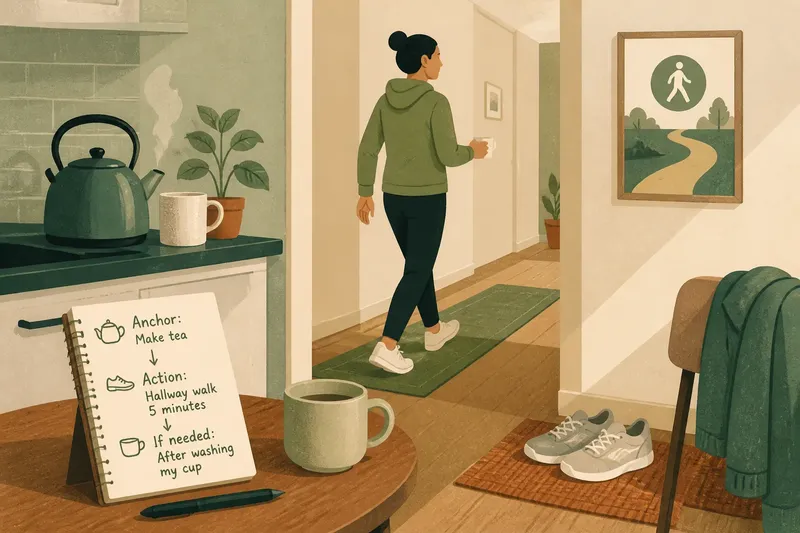
A repeated task is an action you already do in a familiar order: making tea, finishing lunch, or putting away a work bag. Attaching movement to it can suit someone whose day has a steady routine and who finds it helpful to repeat the same connection.
For instance, imagine you already fill a water glass after lunch. You decide that once the glass is on your desk, you will stand and walk to the window and back. The observable result you expect is a brief change of position after lunch; you are not asking the cue to produce a longer exercise session. If lunch shifts or the glass is forgotten, the cue may disappear too, so this approach works best when the task is reliably noticed.
Would a transition cue suit a changing schedule?
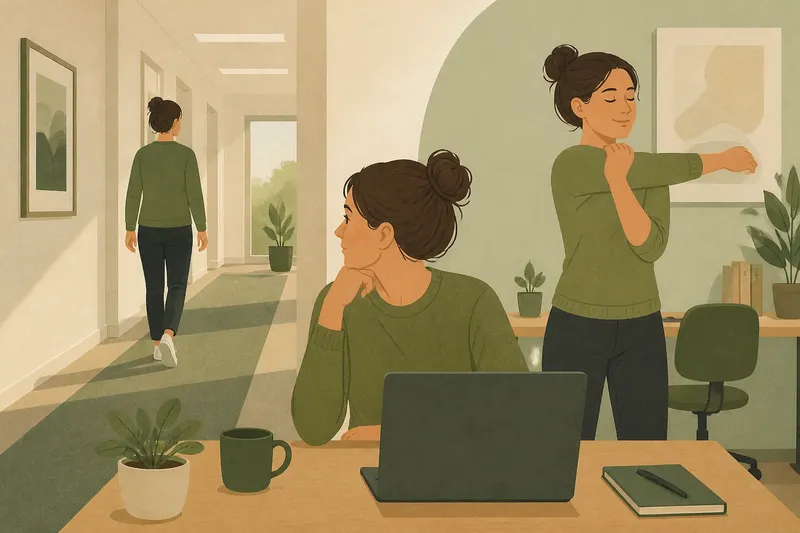
A transition is a natural boundary between activities: finishing a call, closing one document before opening another, or leaving a classroom. It may be more suitable than a fixed clock time when your schedule moves around but your activities still have recognizable endings.
Keep the cue specific enough to distinguish it from every small interruption. “After every task” can be too broad and may become irritating. “After I finish my last call before lunch” creates a clearer opening without assigning movement to every transition in the day.
Can a visible object remind you to move?
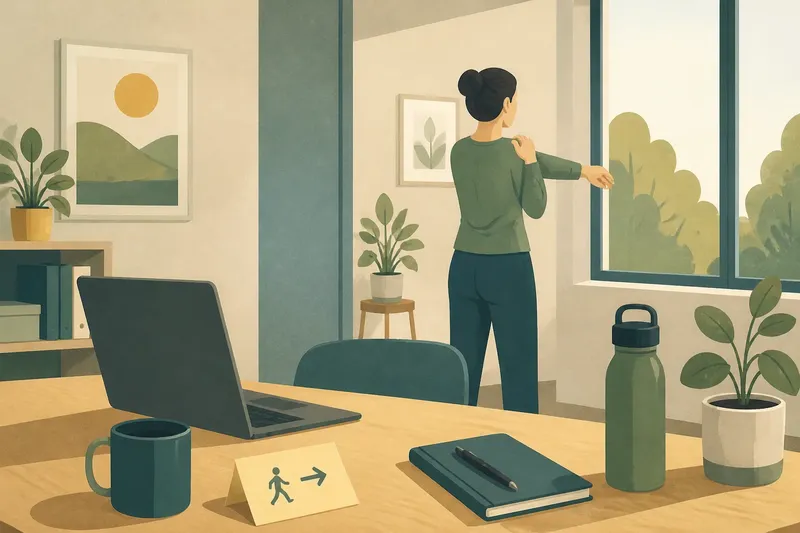
An object can act as a visual prompt when a routine or transition is easy to miss. A water bottle beside your chair, a note near the edge of your desk, or comfortable shoes near the door can remind you of an intended pause. This can suit someone whose work is absorbing or whose daily sequence changes often.
The object should be placed where it will be noticed at a useful moment. A reminder hidden in a drawer is unlikely to help; one that interrupts a task constantly may become background clutter. Treat the object as a prompt to choose, not an instruction that overrides how you feel.
How should you choose between these approaches?
Think about what makes movement easiest to forget. If a dependable everyday task already marks a natural pause, use that task. If your day has shifting hours but clear activity boundaries, choose one transition. If neither is easy to predict, a visible object may help you remember to look for an appropriate opening.
Then consider whether the cue feels supportive or demanding. A cue that ties movement to every cup of coffee could create more interruptions than you want. One tied to a single, manageable moment may feel lighter. You can also pair a cue with a choice of actions instead of a fixed action: when the cue appears, pick one brief movement that suits the space and your comfort.
Say you work at a desk and your meetings end at uneven times. Imagine placing a small note beside your keyboard that says “pause and choose.” After a call, you notice it and decide whether to stand, take a few easy steps, or skip movement because the moment is unsuitable. The expected observable result is that the note brings the possibility of a pause to mind without requiring a set workout or a rigid response.
A good cue makes the beginning clearer while leaving the response flexible.
What can make a movement cue hard to keep?
A cue can become troublesome if it appears too often, arrives during a task that cannot reasonably pause, or points to an action that feels uncomfortable. Rather than treating missed cues as a failure, check the fit. The daily event may be too irregular, the reminder may be easy to overlook, or the movement may need to be simpler.
Try one adjustment at a time. You might move the cue to a more stable task, choose a clearer transition, or place a reminder where it is visible but not distracting. You might also shorten the action to a comfortable change of position. These changes help distinguish a poor fit from a lack of motivation: sometimes the prompt itself is asking too much of the day.
There is no need to make up a missed pause later. If the cue passes, you can wait for the next suitable moment or let the idea go for that day. The purpose is to create an accessible opening, not an accumulating list of obligations.
What do people often ask about movement cues?
Does the movement need to happen at the same time each day?
No. A cue can be an event rather than a clock time, such as finishing lunch or closing a work call. That makes the start point easier to recognize even when the day’s schedule shifts.
Does every cue need to lead to the same movement?
No. A familiar cue can lead to a small choice, such as standing, walking briefly, or moving your shoulders comfortably. Keeping the options simple can make the response more adaptable to the space and moment.
What if I keep forgetting the cue?
Choose a cue that is more visible or more reliably part of your day. If you use an object reminder, put it where you will see it at a sensible pause rather than adding alerts that interrupt unrelated tasks.
Should I move if I feel pain or unwell?
A cue is a reminder, not a reason to push through pain or illness. Pause or choose rest when movement does not feel appropriate, and consult a qualified health professional if you need advice about symptoms or activity limits.
How can a cue remain useful without becoming a plan?
Keep the arrangement light: one cue, a small menu of comfortable actions, and permission to pass when the moment does not suit. If the connection becomes annoying, change or remove it. A cue for movement earns its place by making a beginning easier to notice, not by controlling the rest of your day.
When choosing a cue for movement, favor the one that belongs to a moment you already recognize. That simple connection can make a brief pause easier to begin while leaving the shape of the day—and the movement itself—open.